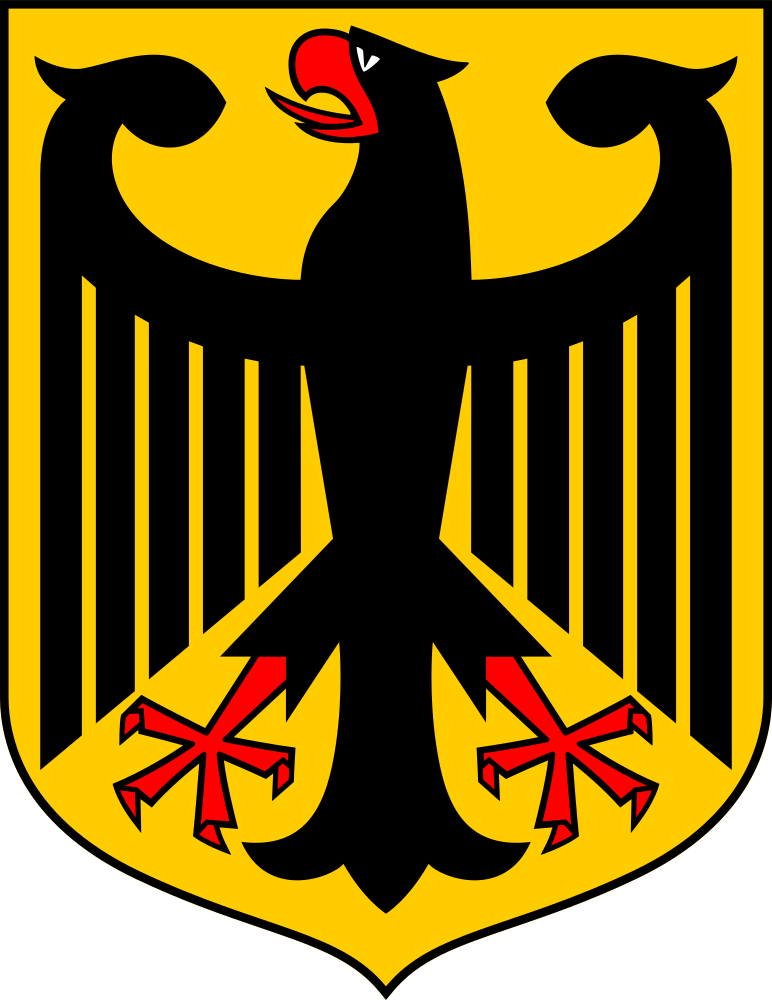


The coat of arms of Germany, the official state emblem of the Federal Republic of Germany, features a golden-yellow shield with a single-headed black federal eagle. The eagle’s head is turned to the left, its wings are spread wide, and its beak, tongue and talons are red. The wing feathers are represented by broad black bands running vertically downward and cut diagonally at the ends. The lower part of the shield tapers to a point. The eagle is one of Germany’s oldest state symbols and traces its origins to the tradition of the Holy Roman Empire. After the establishment of the German Empire in 1871, a single-headed eagle was used, while its form was significantly simplified during the Weimar Republic. The current design is based on a work by Tobias Schwab created in the 1920s and used from 1928. On January 20, 1950, this version was adopted as the federal coat of arms of the Federal Republic of Germany and has remained in use in this form ever since.
The Federal Republic of Germany is a country in Central Europe consisting of 16 federal states. The federal coat of arms is one of the country’s principal state symbols, alongside the black-red-gold flag and the national anthem. The eagle has a centuries-old history in German state symbolism and was used in different forms by the Holy Roman Empire, the German Empire, the Weimar Republic and the Federal Republic of Germany. The current federal coat of arms continues this tradition and is used by German state authorities in official contexts.